AND THEN AGAIN BEGIN
Millington and Jay, two very discreet, middle-aged men living in Montreal, are in the fourth year of a marriage that seems idyllic to their friends. But the marriage is hidden from their parents, who live in St Vincent, and it is fraught with Millington’s problems from untreated trauma and his former career as a Methodist minister. And Then Again Begin (volume 4 of The No Safeguards Quartet) reveals their surprising discoveries as they attempt to resolve these problems.
***
H. Nigel Thomas is a master of dialogue. In this telescoped and diaristic story memory, history, sexuality, religion, masculinity, metropolitan life, and post-colonial life–all collide. The lives lived in these pages are riven by persistent contradictions, pleasures and disappointments. Thomas is at his best as his characters reveal in their own words the many difficult and endearing truths of this powerful tale of familial revelations. This is a story told with bold intimacy from the powerful pen of a writer at the height of his powers.
—Rinaldo Walcott, author of On Property
***
H. Nigel Thomas immigrated to Canada from St Vincent and the Grenadines in 1968. He is the author of dozens of essays, seven novels, three collections of short fiction, two collections of poems, and two academic books. His novels Spirits in the Dark (1993) and No Safeguards (2015) were shortlisted for the Hugh MacLennan Fiction Award. The French translation of Lives: Whole and Otherwise—Des vies cassées—was a finalist for the Carbet des lycéens Award. He is the founder and English-language coordinator of Lectures Logos Readings and is the recipient of many awards; the most recent are Laureate Black History Month (2024), the Canada Council John Molson Prize for the Arts (2022), The Quebec Writers’ Federation Judy Mappin Community Award (2021), and the Martin Luther King, Jr. Achievement Award (2020).
Links to COVERAGE of A DIFFERENT HURRICANE
https://hnigelthomas.org/wp-content/uploads/2025/03/links-to-coverage-of-a-different-hurricane.docx
photos book launch–A Different Hurricane
With thanks to Ella who did the in-store coordination, created the graphic for the launch, and took the photographs; to Moti and Adèle, of Argo Books, who’ve supported my work over the years; to Janis Kirschner, who has enthusiastically publicized the book and the launch, to the audience who braved the cold and snow to support me; to Ethel Meilleur who provided dessert; and of course to Nalini Mohabir who studiously read the novel and prepared a set of insightful and brilliant questions for the interview that began the launch.
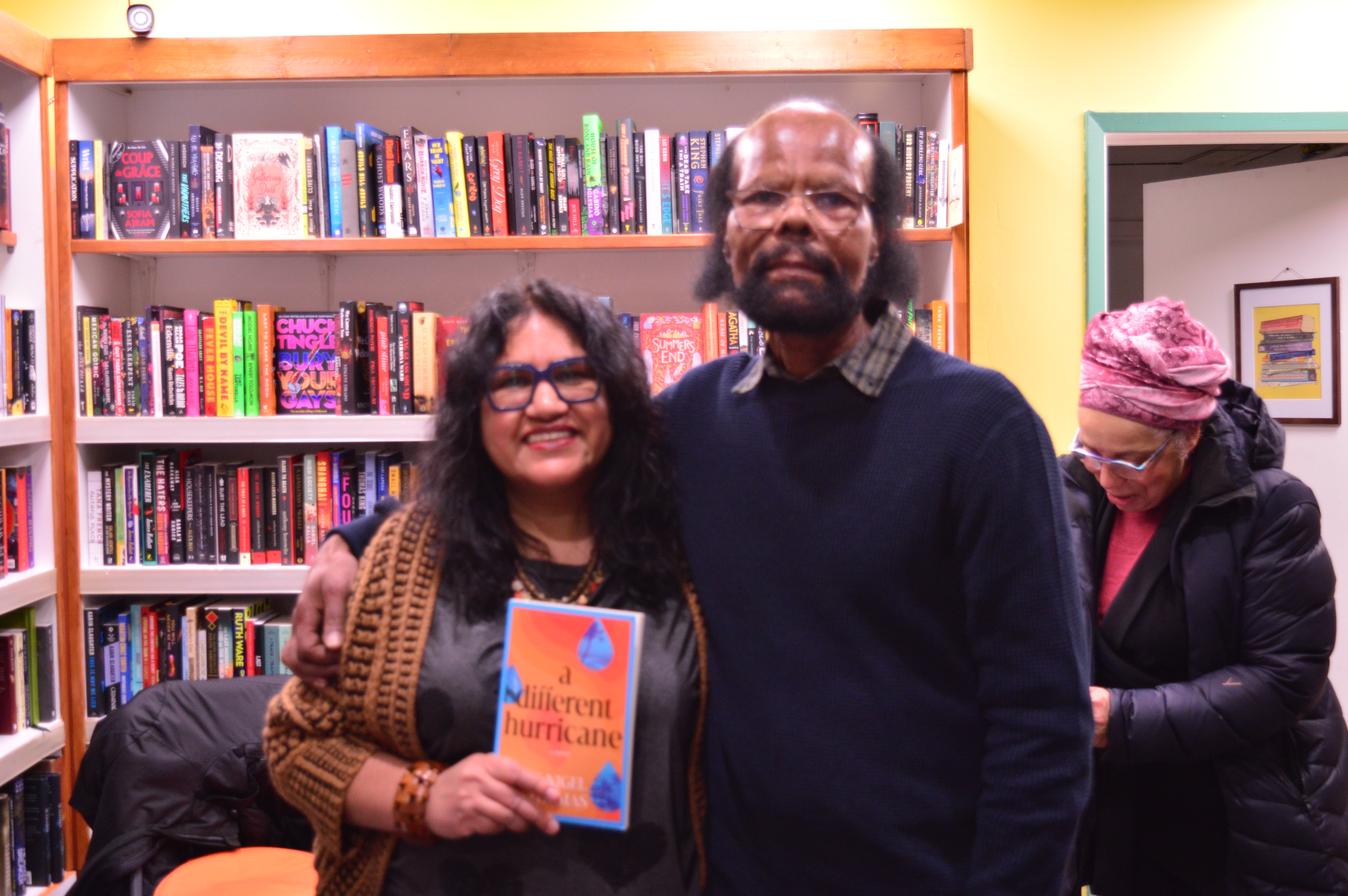
Photo with Nalini Mohabir who did a stellar job interviewing me
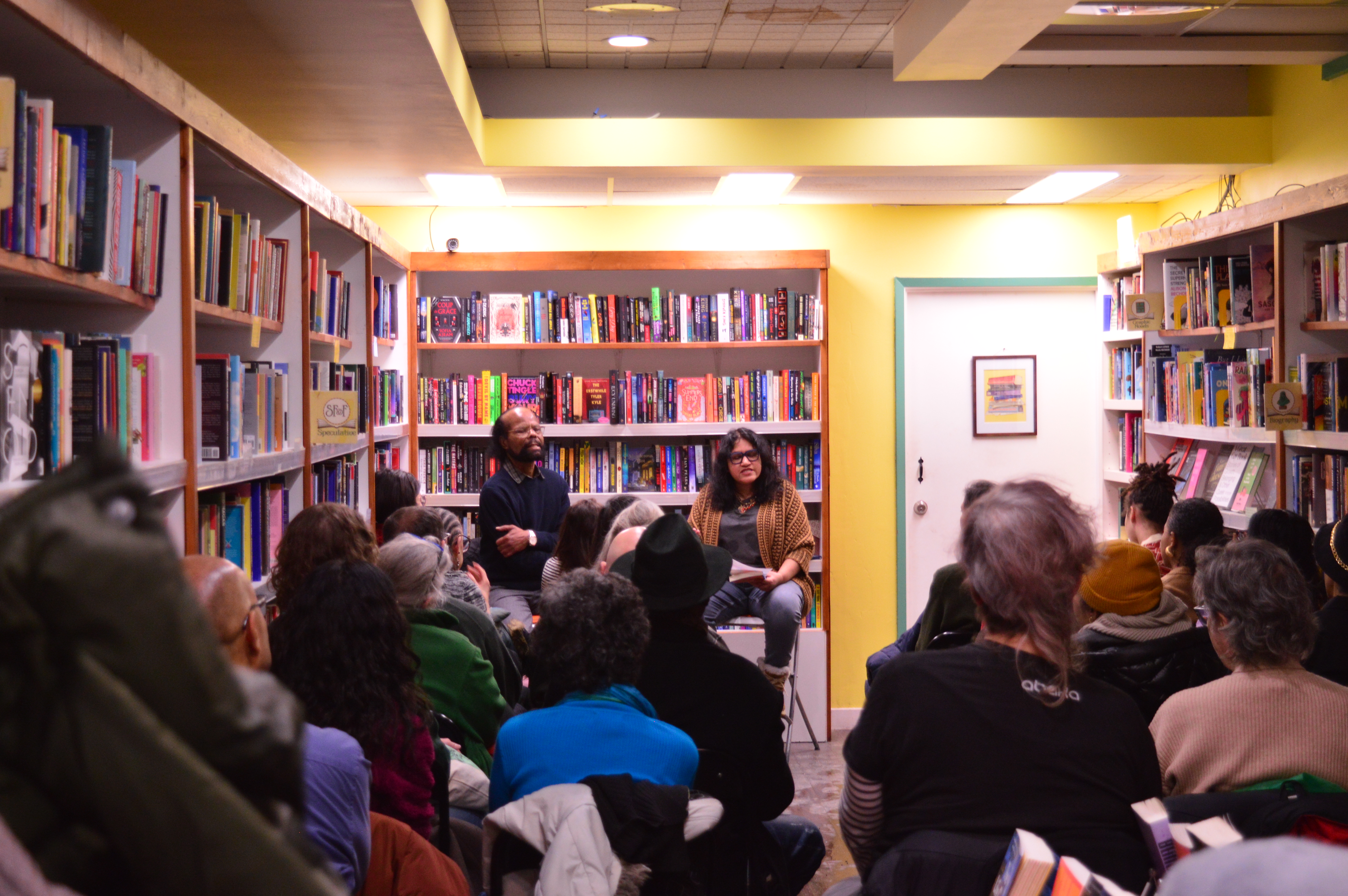
Part of the audience
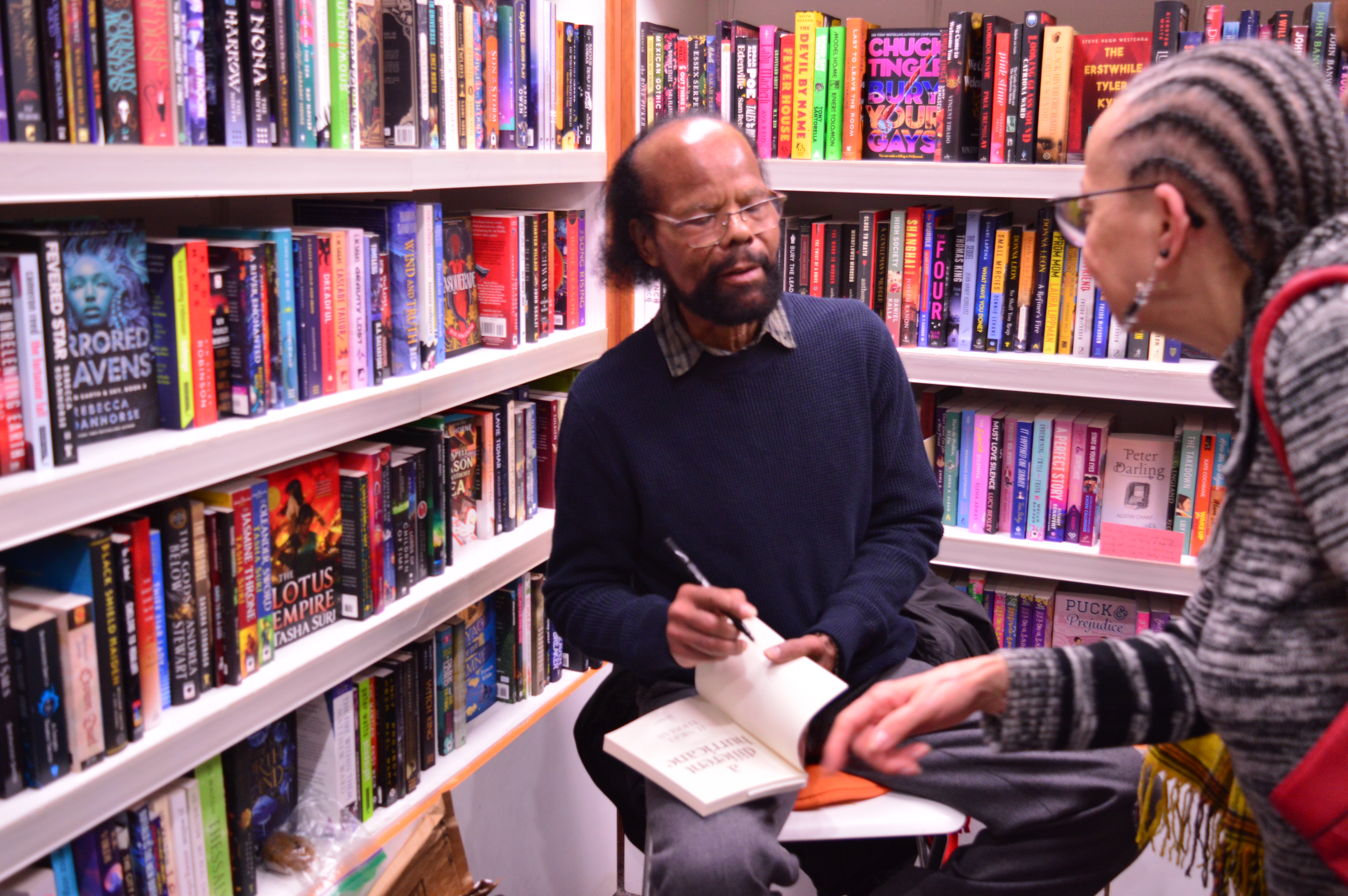
Signing a book for friend and writer colleague Ethel Meilleur
a different hurricane-synopsis
https://hnigelthomas.org/wp-content/uploads/2024/12/adh-synopsis.docx
SYNOPSIS, A Different Hurricane by H. Nigel Thomas, available January 14, 2025
On the morning of Saturday September 9, 2017, while Hurricane Irma is devastating parts of the Caribbean, Gordon Wiley, aged 68, awakens shaken by the news of the murder of Jamaican gay activist Dexter Pottinger. In two days, it will be the first anniversary of his wife Maureen’s death, for which he is partly responsible. Their daughter Frida, who thinks that her father is the paragon of virtue, is arriving from Toronto that same evening so they can visit Maureen’s grave the following Monday.
Dexter Pottinger’s murder plunges a guilt-ridden Gordon into a prolonged reflection on his own gay life. He and Allan Bacchus, who grew up in nearby villages, were lovers until age 29. To circumvent St Vincent’s virulent homophobia, both men first dated women to pass themselves off as heterosexuals. But Maureen’s pregnancy forced Gordon into an unwanted marriage.
Three days after Frida’s birth, Gordon left for Montreal on a scholarship which bonded him to work for the St Vincent and Grenadines government for seven years. As a student in Montreal, at the beginning of the 1980s, Gordon experienced the fullness of gay life without the fears of social and legal persecution. But his irresistible desire to be a hands-on dad and his contract to return to St Vincent triumphed.
After repressing his homosexuality for over a decade, a change in his job required him to make frequent trips to Trinidad and gave him the opportunity to have a gay relationship there, from which he contracted AIDS and in turn infected Maureen.
Allan Bachus is an MD and married to Beth, Maureen’s closest friend and colleague, but has gay lovers. He helps Gordon and Maureen manage their illness in secret. Maureen has recorded the little that she knows in a journal, which, as per her instructions, should remain unread for 25 years after her death. It is all upended during the week that Frida is home.
a different hurricane–book launch
Click on the links for details:
https://argobookshop.ca/events/43927 https://www.ticketsource.us/argo-bookshop/t-lnggroo
Photos from Bocas Lit Fest 2024
What a series of delightful events the 2024 Bocas Lit Fest was! My thanks to the organizers for including me. Here are a few photos:
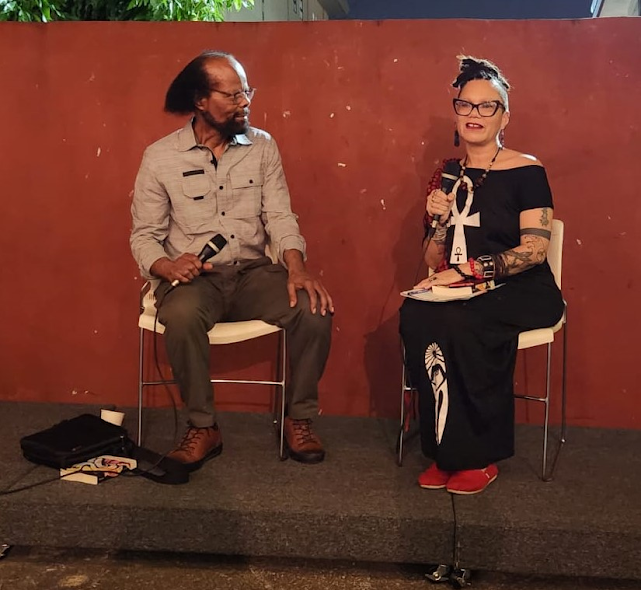
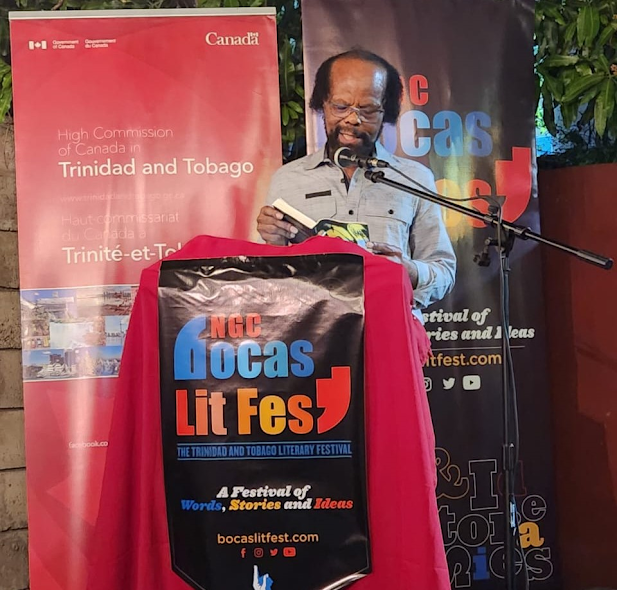
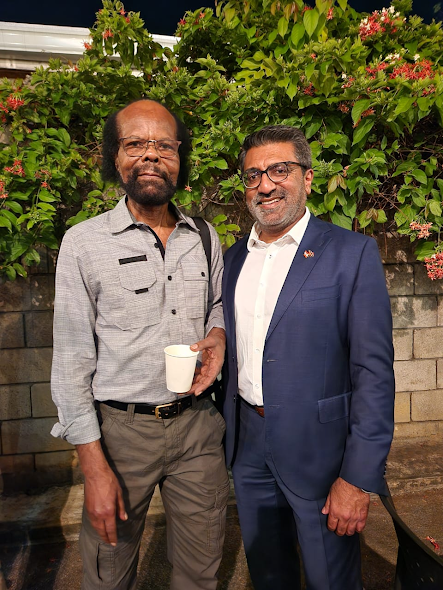
Trinidad and Tobago Arif Keshani–at Bocas Lit Fest 2024
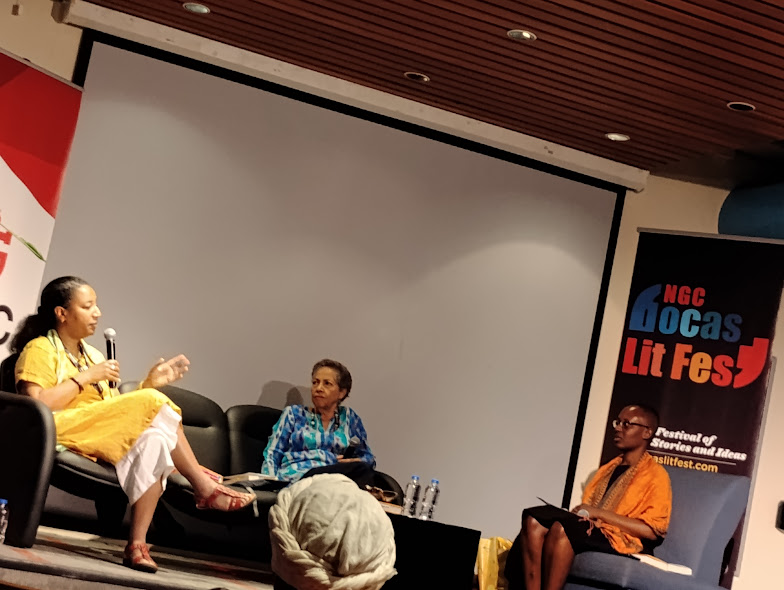
Myriam Chancy in conversation
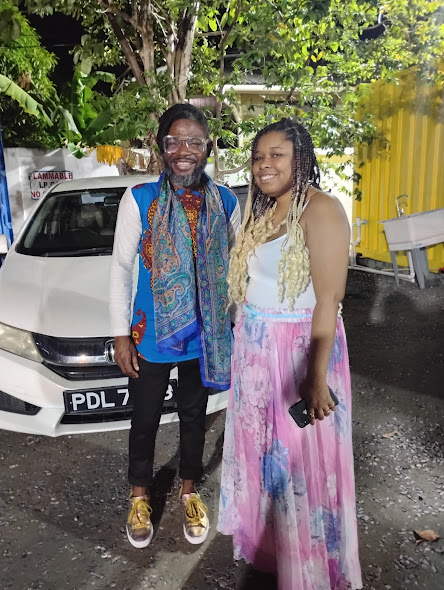

With Dionne Brand and Angelique Nixon
A DIFFERENT HURRICANE–forthcoming novel
https://www.dundurn.com/books_/t22117/a9781459754065-a-https://www.dundurn.com/books_/t22117/a9781459754065-a-different-hurricane
Appearance at Bocas Literary Festival
H[ubert] Nigel Thomas (bocaslitfest.com)https://www.bocaslitfest.com/speaker/h-nigel-thomas/
LINZEY CORRIDON reviews EASILY FOOLED
http://smallaxe.net/sxsalon/reviews/blessings-and-curses-poesis-queer-caribbean-and-diaspora-living
CBC Interviews 2021
Recent Radio Interviews
Easily Fooled (No Safeguards 3)
Today, All Fools’ Day, is the official publication date for Easily Fooled (No fake news here, however). Most of you receiving this email have supported my past work. I deeply appreciate your support. It’s my hope that you’ll get a copy of EF and tell Good Reads, or the 49th Shelf, or Amazon.Ca, or all three about your experience reading it.
Lectures Logos Readings
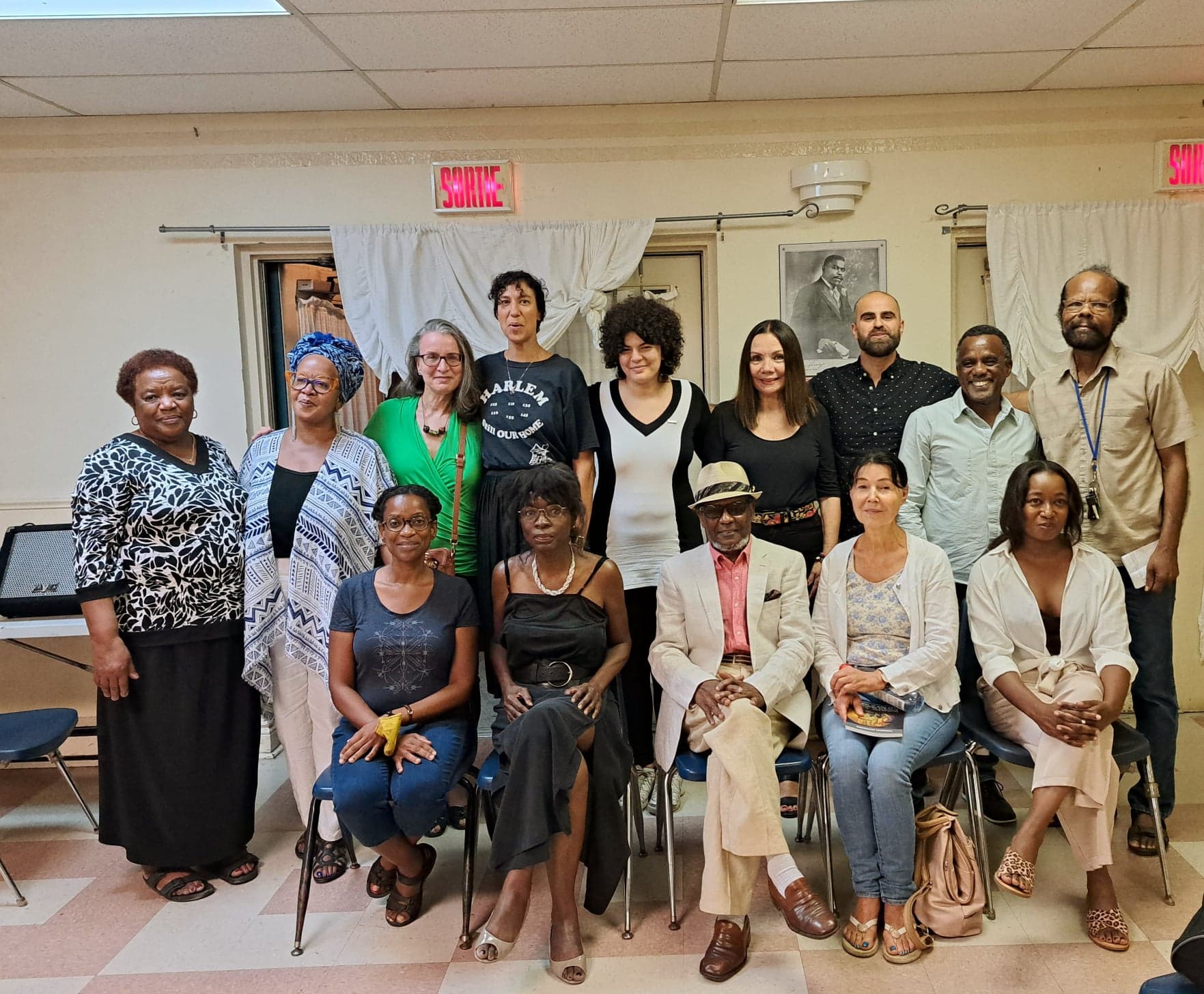
The Lectures Logos Readings team invites you to its next session which will be held on Monday September 8, 2025 at 2741 Notre-Dame West, Montréal, QC H3J 1N9, 7-9 pm. The guest readers are: Chanel Sutherland, Stephanie Roberts, Kelly Nora Drukker, Marlihan Lopez, Nathalie Batraville, Laura Doyle Péan and Uchenna Dike. There’ll be an open-mic session as well with spaces for eight readers.
L’équipe Lectures logos readings vous invite à son prochain événement qui aura lieu lundi le 8 septembre 2025 de 19h-21h au 2741 Notre-Dame O, Montréal, QC H3J1N9. Les lecteurs/lectrices sont : Chanel Sutherland, Stephanie Roberts, Kelly Nora Drukker, Marlihan Lopez, Nathalie Batraville, Laura Doyle Péan et Uchenna Dike Il y aura aussi une session micro-ouverte, limitée à huit participant-e-s.
Nous remercions:



Looking forward to your presence / espérons vous voir.

H[ubert] Nigel Thomas: Biographical Note
I was born on the Caribbean island of Saint Vincent, in a place called Dickson, actually named for one of my colonial ancestors. In fact, my maternal grandfather, in whose household I lived from age three, was John Dickson, grandson of that colonial ancestor.
I am the third of four children—all boys—resulting from my parents’ marriage. I have several half-brothers and a half-sister, my father’s children, some I have not yet met, some with whom I’m in close contact. At an early age I bonded with my maternal grandmother, Hester Roban Dickson, a warm, affectionate woman, in spite of her strict, no-nonsense ways. She died when I was eleven. My grandfather (her husband) was an avid reader. He’d had several careers: shopkeeper, schoolteacher, carpenter, mine manager in Venezuela and Colombia, sugar plantation manager in Cuba. He taught me to read before I went to school, and after that he challenged me to perform beyond the school curriculum; best of all, he was full of stories about his travels and his childhood. I dedicated my novel Behind the Face of Winter to their memory.
I immigrated to Canada in 1968. The reasons were many: 1. I desired to experience life on a continental scale. St. Vincent is about three hundred square kilometres. Most people live in small villages. Life there is very insular and traditional. As a child I was forced to listen to advice, some of it silly, from people whose lives were evident failures. 2. I felt a strong need to go to university, and it was not clear that I would have done so if I’d remained in St. Vincent. 3. There was no space in St. Vincent for someone with a same-sex orientation. One suspected of being gay was verbally harassed; one known to be gay was physically and verbally abused and barred from employment in teaching and the civil service. 4. It’s a society where youngsters, male and female, are flogged in school—sometimes several times in a single day, sometimes during a single lesson—at home; and in the law courts—on the authority of the Old Testament scriptures. It revolted me. (Corporal punishment is still practised there, in schools, in homes and in the law courts, and vigorously defended with sanctimonious and theological arguments).
In Saint Vincent, I worked briefly as an elementary school teacher, a high school teacher, and a civil servant. Shortly after my arrival Montreal in 1968, I studied psychiatric nursing for two years at Douglas Hospital. I worked part-time as a mental health worker while attending Concordia University: 1969-1975, and McGill University: 1975-1976. I graduated with a B.A., 1974; M.A., 1975; and a Diploma in Secondary Education, 1976. In 1976, I began a twelve-year career teaching English and French at the Protestant School Board of Greater Montreal (now the English Montreal School Board), a career I periodically interrupted to pursue doctoral studies at l’Université de Montréal, from which I graduated with a Ph.D. in 1986. In 1988 I began a career as assistant professor of U.S. literature at Université Laval and held the rank of Professeur titulaire when I retired in 2006 to devote myself to writing full-time.
I have been one of the fortunate few who have been able to find rewarding work in their chosen field. At age ten I said that I wanted to become a teacher when I grew up. (I’m not sure I grew up, but I have been a teacher at pretty well all the levels, from kindergarten to doctoral). Childhood caprice? Quite possibly. But it’s a bit more complex. The rural elementary school I attended was staffed by untrained poorly educated teachers, more skilled at imparting welts than knowledge. But that year, 1957, my teacher was Viola John, a trained, intellectually-outstanding, creative woman. I was fascinated by how she taught as well as what she taught. Mrs . John did not flog her students. She had no need to. I wanted to become the sort of teacher that she was.
My arrival in Montreal (at age 21) deepened a compulsion I already had to probe my identity and to resist those who sought to restrict me. Needless to say, those issues, which are ongoing, have influenced my writing. But above all, it’s the mystery of the human psyche that intrigues me—this and the awareness that survival is the fundamental instinct driving human behaviour, even when such behaviour seems inimical to survival. Writing imaginatively is one way for me to explore such issues.


